Share Clarence Benjamin Jones's obituary with others.
Invite friends and family to read the obituary and add memories.
Stay updated
We'll notify you when service details or new memories are added.
You're now following this obituary
We'll email you when there are updates.
Select your format and elements to print

IN LOVING MEMORY OF Clarence Benjamin Jones
Clarence Benjamin
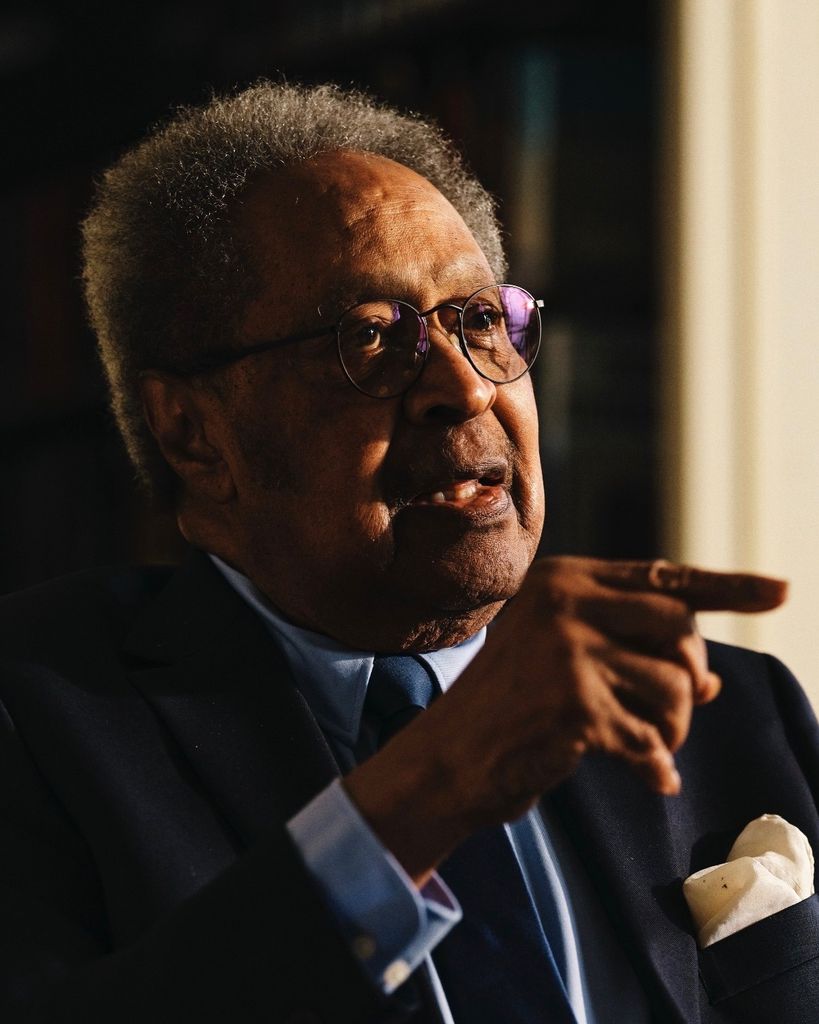
Jones
Jan 8, 1931 — May 22, 2026
Cupertino
Clarence Benjamin Jones' Obituary
FAMILY OBITUARY
Dr. Clarence Benjamin Jones, the New York lawyer who served as Dr. Martin Luther King Jr.'s personal counsel and draft speechwriter from 1960 until Dr. King's assassination in 1968, who helped craft the opening of the "I Have a Dream" speech and smuggled the pages of the "Letter from Birmingham Jail" out of a Birmingham cell, and who in 2024 received the Presidential Medal of Freedom from President Joseph R. Biden Jr., died on May 22 in Cupertino, California. He was 95. Earlier this year, his life and legacy were the subject of The Baddest Speechwriter of All, a documentary that won the Short Film Grand Jury Prize at the 2026 Sundance Film Festival. The film was acquired by Netflix for global release later this year.
Dr. Jones died of natural causes. He had been living in an assisted-living community in Cupertino, California.
Dr. Jones was, in the words of former United Nations ambassador Andrew Young, "the guy that King could trust; no leaks and no grandstanding." For nearly a decade he was a constant presence beside Dr. King: in motel rooms and church basements, on Birmingham jail visits, drafting letters, raising money, fending off libel suits, and ferrying messages between the movement and the centers of American power.
"It wasn't only that Clarence put social justice ahead of making money," the singer and activist Harry Belafonte once said. "He always had the right word to raise the house spirits."
"The Strongest Steel Is Tempered by the Hottest Fire"
Clarence Benjamin Jones was born on January 8, 1931, in Philadelphia, the only child of Goldsborough Benjamin Jones, a butler and chauffeur from Mt. Vernon, on Maryland's Eastern Shore, and the former Mary Elizabeth Toliver, a cook and maid. The two had met in service in Riverton, New Jersey, in the home of Edgar and Eleonora Lippincott at 806 Main Street, and later bought a small house of their own in East Riverton. His father was a devoted member of Mt. Zion African Methodist Episcopal Church in Riverton, where in 2022 a New Jersey historical marker was dedicated honoring the parish and the Jones family. To allow his parents to live and work in their employers' homes, Clarence was placed at age five in a Catholic boarding school in Cornwells Heights, Pennsylvania, run by the Sisters of the Blessed Sacrament, the same order that had raised his mother. He grew up reciting Hail Marys under the care of an Irish nun, Sister Mary Patricia, whom he later credited with teaching him "the meaning of Christian compassion."
The family eventually settled together in Palmyra, New Jersey, where Mr. Jones attended Palmyra High School, was elected president of the honor society, and graduated as valedictorian of the Class of 1949. His graduation speech was titled "Tomorrow, a Better World." He went on to Columbia College, majoring in political science and earning a bachelor's degree in 1953, then served in the U.S. Army at Fort Dix until he was given an "undesirable" discharge in 1955 for declining to sign a federal loyalty oath. With the support of the American Civil Liberties Union, he sued and won an honorable discharge. He used the G.I. Bill to attend Boston University School of Law, where he earned his LL.B. in 1959.
His mother died of cancer on May 4, 1952, when he was twenty-one. He kept the letter she left him, found under her mattress, and called her death the "mountain top of pain" against which every later loss was measured. His enduring motto, drawn from the Long March, was: "The strongest steel is tempered by the hottest fire."
His father died ten years later, in November 1962. As Dr. Jones grieved at the funeral at Mt. Zion AME, Dr. King, unannounced and unexpected, slipped into the back of the church, walked to the pulpit, and asked permission to speak. "I know my friend Brother Clarence is probably surprised that I am here," he began. "I did not know the deceased, his father, Goldsborough Benjamin Jones, but I know his son." Then, looking down into the open casket, he preached directly to the dead man: "Brother Goldsborough, you can rest and go home, because your son…" When he had finished his words of comfort, Dr. King left as quietly as he had come. It was a kindness Dr. Jones never forgot.
A Reluctant Recruit, and a Decade at King's Side
In 1959, Mr. Jones moved with his wife, Anne Aston Warder Norton, daughter of William Warder Norton and Mary Dows Herter Norton, co-founders of W. W. Norton & Company, to Altadena, California, to become associate counsel of Revue Productions, the television arm of MCA that was later renamed Universal Television. In 1960, Dr. King appeared in his Altadena living room, fresh from being indicted in Alabama on perjury charges related to a tax return, and asked him to come south.
Mr. Jones initially declined. "Just because some Negro preacher got caught with his hand in the cookie jar, it's not my problem," he later recalled telling Dr. King. The next Sunday, Dr. King visited Friendship Baptist Church in Baldwin Hills and, in front of Mr. Jones and the congregation, read aloud Langston Hughes's "Mother to Son." It moved him to tears. He joined the team. He never looked back.
Over the next eight years, Dr. Jones helped the Southern Christian Leadership Conference defend itself against a barrage of libel suits brought by Southern officials, a campaign that culminated in the 1964 Supreme Court ruling in New York Times v. Sullivan, the landmark First Amendment case still cited in libel law today. He served as general counsel of the Gandhi Society for Human Rights, the SCLC's fund-raising arm. In April 1963 he drafted the settlement agreement that ended the Birmingham demonstrations and desegregated the city's department stores. Visiting Dr. King in solitary confinement, he repeatedly tucked sheets from a yellow legal pad into his shirt and smuggled them out, pages that were typed, circulated, and printed worldwide as the "Letter from Birmingham Jail."
When bail money was needed, he was instructed to go to Chase Manhattan Bank, where he met with Nelson and David Rockefeller. In the bank vault, he watched as $100,000 in cash was handed to him and put in a briefcase.
In August 1963, he assisted Dr. King in drafting the early portion of the speech that would be delivered later at the Lincoln Memorial. He also took the precaution, after the March on Washington, of filing the copyright application that would keep "I Have a Dream" in the King family's hands.
Dr. Jones also helped draft, with Vincent Harding and Andrew Young, Dr. King's "Beyond Vietnam" address at Riverside Church on April 4, 1967, the speech that, exactly a year to the day before Dr. King's assassination, broke openly with the Johnson administration over the war. He was part of Dr. King's small "research committee" of advisors, and a liaison between Dr. King and Malcolm X, John F. Kennedy, Robert F. Kennedy, and Nelson Rockefeller. F.B.I. transcripts later confirmed that the bureau, on a 1963 memorandum from J. Edgar Hoover to Attorney General Robert F. Kennedy, placed wiretaps on his Riverdale home, his law office, and the Gandhi Society itself.
Wall Street, Attica, Amsterdam News, and the Apollo
In 1967, at the age of 36, Dr. Jones joined the Wall Street firm Carter, Berlind & Weill as a partner. He is widely recognized as the first African American to hold allied-member status at the New York Stock Exchange. He worked alongside Sanford I. Weill, who became a lifelong friend.
After Dr. King's death, his public service did not stop. In September 1971, Governor Rockefeller named him, with Representative Herman Badillo, an official observer during the Attica prison uprising. The two men tried, without success, to dissuade the governor from the armed assault that retook the prison, and Dr. Jones was later appointed chairman of a panel investigating the inmates' constitutional rights. That same year, with the Manhattan borough president Percy E. Sutton, he led a group of Black investors that bought The New York Amsterdam News, the nation's largest Black community newspaper, and the Harlem radio station WLIB. He served as the newspaper's publisher for three years. His association with Sutton's Inner City Broadcasting Corporation continued into the 1980s, when he helped launch the television show It's Showtime at the Apollo. He returned to financial services in his later business career, working with the accounting firm Marks Paneth & Shron.
Stanford, USF, and a Life in Honors
In 2006, Dr. Jones moved to the West Coast, where he began the academic life that would occupy his final two decades. From 2006 to 2012 he was a scholar in residence at the Martin Luther King Jr. Research and Education Institute at Stanford University. From 2012 onward he was a Diversity Visiting Professor and Scholar in the College of Arts and Sciences at the University of San Francisco. In 2018, with his colleague Jonathan D. Greenberg, he co-founded the University of San Francisco Institute for Nonviolence and Social Justice, dedicated to teaching the principles of Dr. King and Mohandas K. Gandhi to a new generation.
These years brought a steady stream of recognition for a life's work in civil rights. In 2006, his alma mater, Boston University School of Law, presented him with its Silver Shingle Award for Distinguished Service to the Profession. That same year, the American Jewish Congress honored him with its Isaiah Award for Lifetime Achievement, the first of several recognitions of his lifelong commitment to Black and Jewish cooperation. In 2012, Georgetown University presented him with its John Thompson Jr. Legacy of a Dream Award at the annual Let Freedom Ring celebration at the Kennedy Center. In 2014, he received the 23rd Annual Martin Luther King Jr. Award, given jointly by the Consulate General of Israel, the Jewish Community Relations Council of New York, and the Jewish National Fund. In that same spirit, he served as chairman of the Spill the Honey Foundation, dedicated to dialogue between Black and Jewish communities.
In 2015, President Barack Obama welcomed Dr. Jones and family members to the White House to celebrate Black History Month. In June 2017, he returned to Palmyra, New Jersey, nearly seventy years after his valedictory address, for the dedication of the Dr. Clarence B. Jones Institute for Social Advocacy at his old high school. The same trip brought a long-postponed grace: with the help of a friend in the area, he visited the graves of his mother and grandmother at Eden Cemetery outside Philadelphia, and his father's grave at Sunset Memorial. "Coming back to Palmyra is less about me," he wrote at the time. "It's all about them, and the parents of so many other disadvantaged African American children, whose families tried to do the best they could for their children, like my parents did for me."
He was the author or co-author of four books: What Would Martin Say? (HarperCollins, 2008, with Joel Engel), Behind the Dream: The Making of the Speech That Transformed a Nation (Palgrave Macmillan, 2011, with Stuart Connelly), the e-book Uprising: Understanding Attica, Revolution and the Incarceration State (with Stuart Connelly), and Last of the Lions: An African American Journey in Memoir (Redhawk Publications / UNC Press, 2023). His life and work were the subject of the 2026 short documentary The Baddest Speechwriter of All, co-directed by Ben Proudfoot and Stephen Curry, Mr. Curry's directorial debut, which won the Short Film Grand Jury Prize at the Sundance Film Festival in January 2026 and was acquired by Netflix the following month for worldwide streaming release later in the year. "This is a man who not only observed but actively influenced the Civil Rights Movement from within," Mr. Proudfoot said of Dr. Jones at the time of the Netflix deal.
"We're Not Going Back"
In May 2026, frail and using a wheelchair, Dr. Jones made an appearance at the 69th San Francisco International Film Festival, where he received a standing ovation. Asked whether the recent rollback of the Voting Rights Act might return the country to the Jim Crow era, he was characteristically defiant.
"Everybody's trying to sound the alarm bell," he told the San Francisco Chronicle. "We're not gonna go back there." And then, quoting a line he had loved all his life: "More powerful than the march of mighty armies is an idea whose time has come."
Survivors
He is survived by his five children, Christine T. Jones-Tucker (Edward), Alexia N. Jones, Clarence B. Jones Jr., known as Ben (Kristen), and Dana N.G. Jones, from his marriage to Anne, and Felicia E. Jones, from his marriage to Jennifer Poznanski; his longtime partner, Lin Walters; and a world of former students, colleagues, and friends.
The family extends special gratitude to Ben F. Hill, Dr. Jones's chief of staff and trusted confidant, whose loyalty, counsel, and care were invaluable during the final years of his life. The family thanks the staff of The Forum, in Cupertino, California, for their extraordinary care, and asks for privacy as they mourn.
A private family service for Dr. Jones will be held at Historic Eden Cemetery. The family is planning a public memorial service in New York City in the fall. Service details, as they are confirmed, will be shared at cbjonesmemorial.com. In lieu of flowers, the family has requested that donations be made to the Dr. Clarence B. Jones Institute for Social Advocacy.
Consider a donation, as requested by the family.

Clarence Benjamin Jones' Guestbook
Visits: 461
This site is protected by reCAPTCHA and the
Google Privacy Policy and Terms of Service apply.
Service map data © OpenStreetMap contributors